
In short: this lift compliance checklist covers what the person responsible for a lift needs in place: a register of your lifts, a thorough examination at least every 6 months for lifts that carry people (12 months for goods-only lifts), defects put right by the dates in the report, planned servicing, a working alarm, the contractor’s paperwork and the records to prove it. Tick it off below, build a calendar of what is due for each lift, and print it or add it to your own calendar.
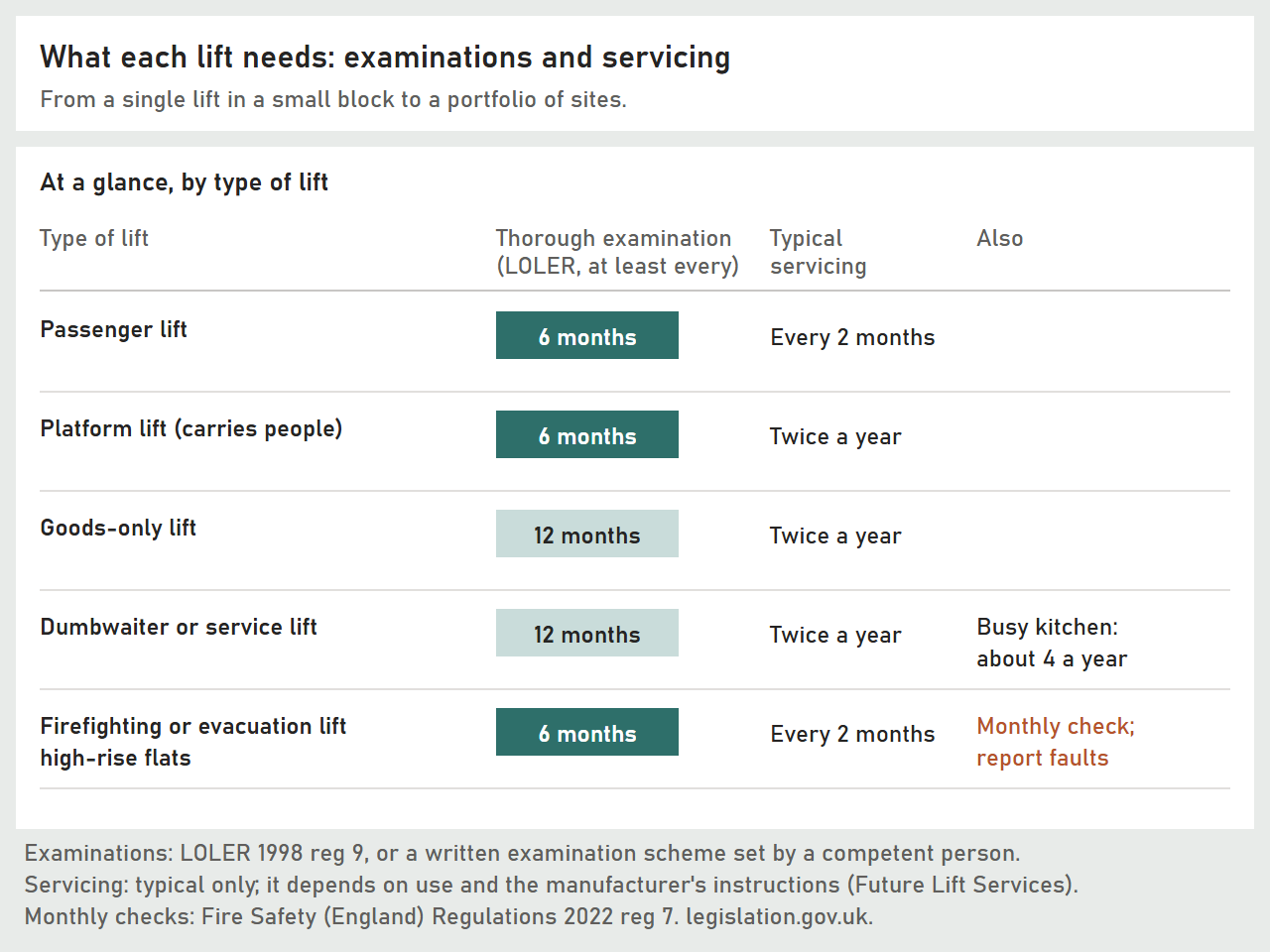
Lift compliance checklist at a glance: lifts that carry people need a thorough examination at least every 6 months and goods-only lifts every 12 months, with typical servicing intervals for each type of lift
Figure 1. What each type of lift needs. Examination intervals are set by LOLER 1998 regulation 9, unless a competent person sets a written examination scheme. Servicing intervals are typical only: the right interval depends on how much the lift is used and on the manufacturer’s instructions.

This guide is for anyone responsible for a lift: facilities managers looking after offices, schools, shops, hotels and healthcare sites, managing agents and residents’ management companies with a single lift in a small block of flats, and owners of a building with one goods lift or platform lift. We look after lifts across Essex, London and the South East, and we work nationwide with our engineers. Everything here is drawn from the regulations and HSE guidance, with links so you can check it. It is not legal advice: check your own duties, leases and insurance, and take advice where you need it.

Lift compliance checklist: 17 checks

Tick each check as you go. Your ticks are saved only in this browser, on this device.

Know your lifts

Thorough examinations (LOLER)

Maintenance

Alarms and emergency calls

Contractor paperwork

Records

High-rise residential and incidents

'+ '

Lift compliance checklist

Printed '+fmt(new Date())+'. From futureliftservices.co.uk. Not legal advice.

'+list+ '

Your lift calendar: the next 12 months

'+(out.querySelector('table')?out.querySelector('table').outerHTML:'

No dates entered.

')+''); w.document.close();w.focus();setTimeout(function(){w.print()},300)}); })();

Build your lift maintenance schedule and calendar

Below the checklist on our website is a calendar builder. Add each lift, choose its type, and enter the date of its last thorough examination and its last service. It fills in the usual intervals for that type of lift, which you can change if your examiner, the manufacturer or your contract says otherwise. It then lists everything due in the next 12 months, and flags anything already overdue. It works as a lift maintenance checklist and calendar in one.

You can print the result with the checklist, or download it as a calendar file that opens in Outlook, Google Calendar or Apple Calendar, so the reminders sit alongside the rest of your work. Nothing you type leaves your device: there is no sign-up, and we don’t see your data.

Lift compliance checklist example year for one passenger lift: thorough examinations in months 3 and 9, servicing every two months, paperwork checked yearly and the alarm line moved off analogue
Figure 2. An example lift maintenance schedule for a small block or office with one passenger lift. Your own dates will differ: use the calendar builder to make yours.

Who is responsible for the lift compliance checklist?

The HSE calls the person responsible a “dutyholder”. If you own a lift used at work, or you are responsible for its safe operation, such as a facilities manager or supervisor, the Lifting Operations and Lifting Equipment Regulations 1998 (LOLER) make you responsible for making sure it is thoroughly examined and safe to use. The HSE’s leaflet for lift owners lists the duties:

  • keep the lift maintained so that it is safe to use;
  • choose and instruct a competent person to examine it;
  • have it examined at the legal intervals, or to a written examination scheme;
  • tell the examiner about changes in how the lift is used;
  • give the examiner the documents they need, such as the manufacturer’s instructions and maintenance records;
  • act promptly on defects;
  • make sure the paperwork meets the law, and keep the records.

You can read the HSE leaflet, Thorough examination and testing of lifts, in full.

Lifts in smaller blocks of flats

In blocks of flats, landlords and managing agents usually arrange thorough examinations to the same standard as a workplace lift, and insurers commonly require them. The HSE also says that where LOLER may not strictly apply to a lift used by people who are not at work, a similar regime of maintenance, inspection and examination may be entirely reasonable under health and safety law. In practice, treat a lift in a small block the same way as a lift in an office. The lift compliance checklist above works just as well for one lift as for fifty.

Thorough examinations: the heart of the lift compliance checklist

A thorough examination is a systematic, detailed examination of the lift by a competent person, looking for defects that are, or could become, dangerous. The HSE lists what it should include: landing and car doors and their interlocks, gearing, the main drive, governors, safety gear, suspension ropes or chains, overload devices, electrical safety devices, brakes, buffers and overspeed devices, and hydraulics. It may include tests where the examiner thinks they are needed.

How often

LOLER requires a thorough examination at least every 6 months for lifting equipment that lifts people, and at least every 12 months for other lifting equipment. A competent person can instead set a written examination scheme with different intervals, based on a rigorous risk assessment, for example for a lift used rarely and for light loads. If you use a scheme, keep a written copy: without one, an inspector will assume the legal intervals apply.

A fresh examination is also needed after “exceptional circumstances” that could affect safety, such as damage, failure, a long period out of use or a major change in how the lift is used.

Who examines it

The examiner must be competent and, says the HSE, sufficiently independent and impartial: “it is not advisable for the same person who performs routine maintenance to carry out the thorough examination”. UKAS accreditation is one sign of a competent inspection body, and most insurers can recommend one. We arrange LOLER thorough examinations, carried out by an independent examiner, so every examination stays impartial, and then we carry out the repairs the report asks for. See our LOLER examinations page.

The report and defects

The examiner must tell you straight away about any dangerous defect, and send a signed written report as soon as practicable. The HSE says normally within 28 days, sooner for serious defects. If a report says a defect is serious, take the lift out of service until it is fixed. If it gives a date for a repair, the lift must not be used after that date unless the repair has been done. A report missing the information the law requires should not be accepted.

Our LOLER inspection guide explains the report and the three kinds of finding in more detail.

Servicing: your lift maintenance checklist between examinations

A thorough examination is not maintenance. The HSE puts it plainly: an examination “may act as a check that maintenance is being carried out properly, but is not intended to replace it”. Separately, the Provision and Use of Work Equipment Regulations 1998 require work equipment to be kept “in efficient working order and in good repair”, and any maintenance log to be kept up to date.

How often a lift needs servicing depends on how much it is used and on the manufacturer’s instructions. As a guide, we typically service passenger lifts every two months and most other lifts twice a year. A dumbwaiter in a busy kitchen usually needs about four visits a year. Our lift maintenance page explains what a planned service covers, and our guide to lift maintenance contracts explains what to look for in a contract.

A good lift maintenance checklist for each visit ends with a report. We email ours after every service, repair and examination, so the records build up without anyone chasing them.

Alarms, emergency calls and the analogue switch-off

A trapped passenger needs to reach someone who can help. Check that the alarm works, that calls are answered by someone who can act, and that the line still connects. Many older lift lines use traditional analogue phone lines. The switch-off of those lines is reported to be due by 31 January 2027, so any lift alarm still relying on one needs a plan to move to a digital or mobile connection before then. Ask your lift contractor to confirm what each lift uses. Our lift emergency phone guide explains the options.

Contractor paperwork to keep on file

FM teams most often ask us for four things, and they belong in every lift file alongside your lift compliance checklist:

  • service reports after every visit;
  • LOLER thorough examination reports;
  • RAMS (risk assessments and method statements) before work starts;
  • insurance certificates and accreditation: we are SafeContractor accredited.

Records the lift compliance checklist asks for

LOLER sets out how long to keep examination reports. Keep each periodic thorough examination report until the next one is made or for two years, whichever is later, and keep the declaration of conformity for as long as you use the lift. Records can be kept electronically, as long as you can produce a written copy. Keep alongside them the service reports, repair records, alarm tests and your register of lifts.

Extra duties: high-rise flats and serious incidents

Firefighting and evacuation lifts in high-rise residential buildings

If you manage a residential building at least 18 metres or seven storeys high, the Fire Safety (England) Regulations 2022 add monthly checks of firefighting and evacuation lifts, a record residents can see, and a report to the fire and rescue service if a fault isn’t fixed within the 24-hour period. Our guide to fire safety and lifts explains these lifts in more detail.

RIDDOR

The collapse, overturning or failure of any load-bearing part of lifting equipment is a “dangerous occurrence” under RIDDOR 2013, and must be reported to the HSE.

The gaps we find most often

When we take over lifts from another contractor, the same four gaps come up again and again:

  • overdue examinations: a thorough examination late, sometimes by months;
  • defects not closed from the last report, with no proof they were fixed;
  • missing records: no service history or reports to hand;
  • alarms not working, or never tested.

Each one is on the lift compliance checklist above, and each is easy to fix once you know about it.

Lift compliance checklist and why it matters: station lifts in Great Britain had 9,857 faults in 2025/26, 7.0 per lift, mostly from wear and tear and misuse
Figure 3. Published fault data for lifts at Network Rail stations in Great Britain: 9,857 faults took a lift out of service in 2025/26, 7.0 per lift, with an average repair time of 20.2 hours. 59% came from wear and tear, 28% from misuse and vandalism and 13% from causes outside the lift. Station lifts are heavily used public lifts, so they are not typical of offices or flats, but they show why planned maintenance and quick reporting matter. Source: Office of Rail and Road, Table 4521.

Smaller blocks and single lifts: keep it simple

If you look after one lift in a small block or a single building, you don’t need a system: you need four dates and a folder.

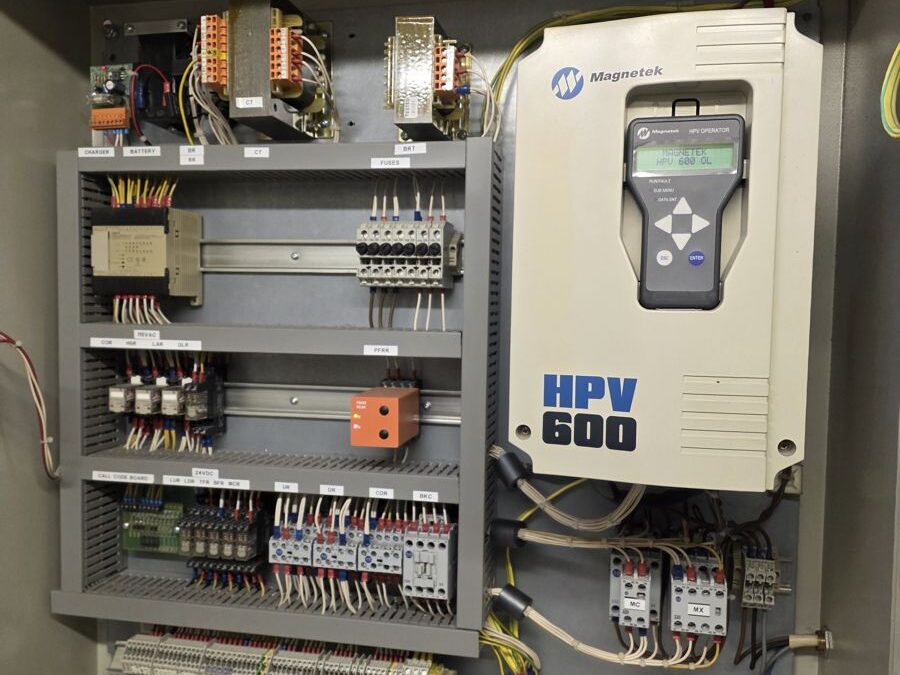
Lift compliance checklist: the control panel of a goods lift on one of our visits
A goods lift control panel on one of our visits. The folder of reports matters as much as the lift itself.
  • the date of the last thorough examination, and when the next is due;
  • the date of the last service, and when the next is due;
  • the date any defects on the last report must be fixed by;
  • the date the alarm was last tested.

Put those four dates into the calendar builder above, download the calendar file, and keep every report in one folder, paper or digital. That covers most of the lift compliance checklist for a single lift, and gives you a simple lift maintenance checklist for the year.

Portfolios: running the lift compliance checklist across many sites

For facilities teams with many sites, the challenge is consistency:

  • One register: every lift across every site, with its type, examination interval and contractor, ideally in your CAFM system.
  • Planned maintenance standards: many FM teams build schedules from SFG20, the industry’s planned maintenance standard, and match the lift tasks to the manufacturer’s instructions.
  • Reports in one format: ask contractors to send service and examination reports after every visit, so they can be filed against the right asset.
  • Defect tracking: log every defect from every report with its deadline, and close it with evidence.
  • Simple measures: track each thorough examination done on time, defects closed on time, call-outs per lift and repeat faults.

Questions to ask your lift contractor

  • Which of our lifts carry people, which are goods-only, and which are firefighting or evacuation lifts?
  • When is each lift’s next thorough examination, and who arranges it?
  • How will defects from the report be quoted for and fixed before the deadline?
  • How often will each lift be serviced, and why that interval?
  • Will we get a report after every visit, and in what format?
  • What does each lift alarm connect to, and is it on an analogue line?
  • Can you send RAMS, insurance certificates and accreditation before work starts?

If you would like us to look at your lifts and your paperwork, contact us for a free lift survey and quote. Our office is open 08:00 to 17:00, Monday to Friday, on 01708 986845. Contract customers should use the number in their contract or on the lift.

Questions people ask

How often does a lift need a LOLER thorough examination?

At least every 6 months if it carries people, and at least every 12 months if it carries goods only, unless a competent person sets a written examination scheme.

Is a lift service the same as a thorough examination?

No. Servicing keeps the lift working; the thorough examination is an independent check of its safety. You need both.

How long must lift examination reports be kept?

Until the next report or for two years, whichever is later. Keep the declaration of conformity for as long as you use the lift.

Does a lift in a small block of flats need the same checks?

In practice, yes. Landlords and managing agents usually arrange thorough examinations to the same standard, and insurers commonly require them.

Does the interactive checklist store my data?

Only in your own browser, on your device. Nothing is sent to us or anyone else.