

In short: most lift emergency phone systems still call out over a traditional phone line, and Openreach says that “On 31 January 2027, all traditional phone lines will be going digital”. A lift alarm left on an old line may stop getting through. The usual fix is a GSM (mobile) unit for a fairly new, working auto dialler, or a new auto dialler with built-in GSM for an older or unreliable one. Use the helper below to see what yours needs, and send it to us for a no-obligation quote.

What does your lift alarm need? Get a quote
Answer five quick questions: what the lift alarm connects through now, whether it works, how old the auto dialler is, how many lifts you have, and whether you need someone to answer the alarm calls. The helper suggests a fix, with the reasons, and puts your answers into the quote form below it. Add your details and press Send. Nothing is sent until you do.
We don’t show prices online, because every lift and building is different. We get back to you with a quote, with no obligation on your part to go ahead.
What does your lift alarm need?
Five quick questions for a suggested fix, then send it to us with the quote form below. Not sure what you have? Choose “Don’t know” and send us what you can. We get back to you with a quote, with no obligation on your part. Nothing is sent until you press Send on the form.
Done: your answers are in the form below. Add your details and press Send, and we will get back to you with a no-obligation quote.
We’ll get back to you with a quote. There’s no obligation to go ahead. We use the details you send only to reply to your request: see our privacy policy.
Get a no-obligation lift alarm quote
Not sure what your lift emergency phone uses?
That’s fine: most people don’t know what their lift emergency phone connects through, or how old it is. Choose “Don’t know” in the helper and send us what you can. Useful things to tell us:
- the building address, and how many lifts there are;
- the lift make, which is often on a plate in the lift car or on the landing buttons;
- the name and number on any lift company sticker in the car;
- photos of the alarm button and the speaker panel inside the car.
Put what you know in the form, or email your photos to admin@futureliftservices.co.uk. We’ll look at what you send and tell you the next step. Please don’t go on top of the lift or into the lift machinery to look: leave that to an engineer.
Who this guide is for
This guide is for anyone responsible for a lift: managing agents and residents’ management companies, facilities managers, and owners of offices, hotels, shops, schools, care homes and small blocks with a single lift. We look after lifts across Essex, London and the South East, and we work nationwide with our engineers.
In this guide
Lift emergency phone switchover at a glance


How a lift emergency phone works
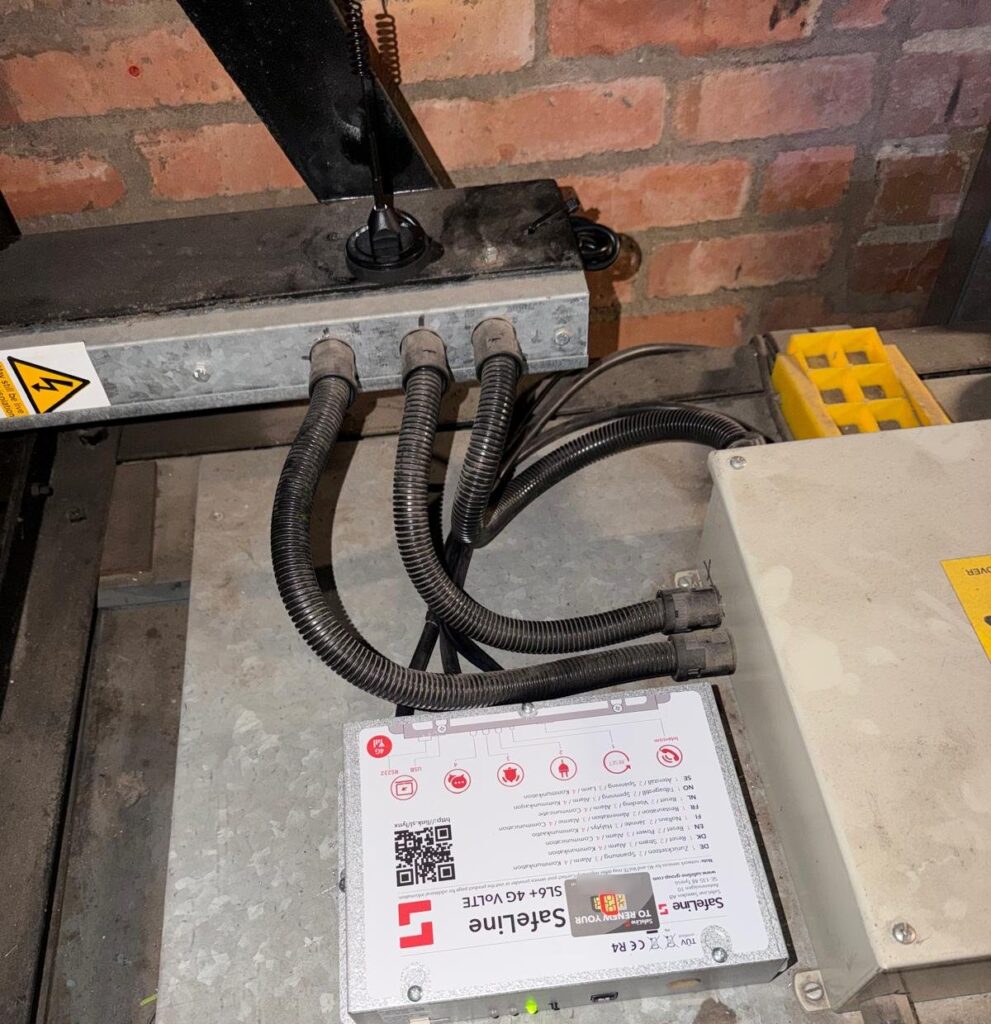
Every lift car has an alarm button. Press it, and the lift emergency phone calls a rescue service so the trapped passenger can talk to someone who can send help. In its note for the lift industry, Openreach describes how this usually works: “It works by using an auto-dialler”, which “sits on top of the lift car and is plugged into the phone line using an Openreach master socket.”
The auto dialler holds the number to call. When the alarm is pressed it dials out, sends a code that identifies the lift, and opens a two-way speech link. Many lift emergency phones also make automatic test calls, so the rescue service knows the line still works.
The rescue service is often run by the lift company, but not always. Either way, the link between the lift and the people who answer has, for decades, been a traditional copper phone line. That is what is changing.
What happens on 31 January 2027
Openreach is moving every traditional phone line in the UK to digital. In its own words: “On 31 January 2027, all traditional phone lines will be going digital.” It adds: “If you haven’t switched by then, your service may be limited.”
Lines that haven’t moved may be put onto a temporary emergency voice-only service, which Openreach calls EVAc. It “may not support all calling features”. A lift emergency phone depends on more than an ordinary voice call: the auto dialler has to send its identifying code and make test calls. So don’t rely on a temporary service to keep a lift alarm working. Openreach’s business guidance lists “lift systems” and “lift phones” among the equipment to check before you switch.
Why lift alarms are at risk on digital lines
Openreach’s note for the lift industry lists the problems lift alarms can hit on digital lines:
- Signalling: “A loss of support for high speed Dual Tone Multi Frequency (DTMF) signalling”, the tones many auto diallers use to send their codes.
- Power: “The router will require a battery back up”. A digital line runs through a router, and without battery backup a power cut could cut the lift emergency phone off when it is most needed.
- Mobile signal: “Mobile phone signals can be hampered by the surrounding metal”, which is why a GSM unit’s aerial position matters in a lift shaft.
It also says plainly: “Every building with a lift will need to upgrade their alarm system to work with Digital Phone Lines.”
Your options: a GSM unit or a new auto dialler
For most lifts, the answer is to stop relying on the phone line altogether, and send the alarm calls over the mobile network instead.
A GSM unit for your existing auto dialler
If the dialler is fairly new and working well, adding a GSM unit is usually enough. The alarm calls go over the mobile network instead of the old line, and the dialler you already have keeps doing its job.
A new all-in-one auto dialler (what we recommend)
If the dialler is older or unreliable, it is usually better to replace it than to patch it. The unit we recommend and fit is the SafeLine SL6+ 4G: an all-in-one auto dialler with a built-in 4G connection and its own backup battery. It moves the lift off the old line and gives you a fresh, tested lift emergency phone in one step. Because it calls over 4G, it doesn’t depend on the 2G and 3G networks that are being switched off.
Someone to answer the calls
A lift emergency phone is only as good as the people who answer it. If you don’t already have a rescue service answering your lift alarm calls, we can arrange it.
A changeover usually takes about half a day on site per lift. Which mobile network and SIM arrangement suits your site depends on the building and the signal in the shaft, and we confirm it before we fit anything.
What a good lift alarm upgrade includes
Whichever fix you choose, a proper upgrade is more than plugging in a box. Expect your lift company to:
- check the mobile signal where the unit will sit, because a lift shaft is surrounded by metal and concrete;
- fit and set up the unit, including the numbers it calls and the code that tells the rescue service which lift is calling;
- check the power supply, so the alarm keeps working in a power cut;
- make a live test call from the lift car, and confirm the rescue service can hear the passenger clearly;
- confirm the automatic test calls are reaching the rescue service;
- label the equipment and give you a written record of what was fitted and tested.
If any of these is missing from a quote, ask why.
On the day of the changeover
Most changeovers take about half a day per lift, and the lift is usually out of service for part of that time. In a block of flats, put up a notice a few days before, and check whether any resident relies on the lift to get in and out. In a workplace, plan the visit for a quieter time. When the work is finished, the engineer tests the new connection from inside the car, and the lift goes back into service. Keep the test record with the lift’s other paperwork.
Planning upgrades across many buildings
Facilities teams and managing agents with many lifts should start with a simple list: every lift, its address, what its alarm connects through, and how old the equipment is. Then put the work in order:
- Lifts with no working alarm come first, whatever they connect through.
- Lifts still on traditional lines come next, because of the 31 January 2027 date.
- Lifts used by people who can’t use the stairs, such as in care homes, sheltered housing and blocks with vulnerable residents, should not be left to the end.
- Lifts already on GSM can follow, once you know which mobile network each one uses.
Grouping lifts by site keeps visits efficient, and one record for the whole estate makes the next audit easy.
Power cuts and battery backup
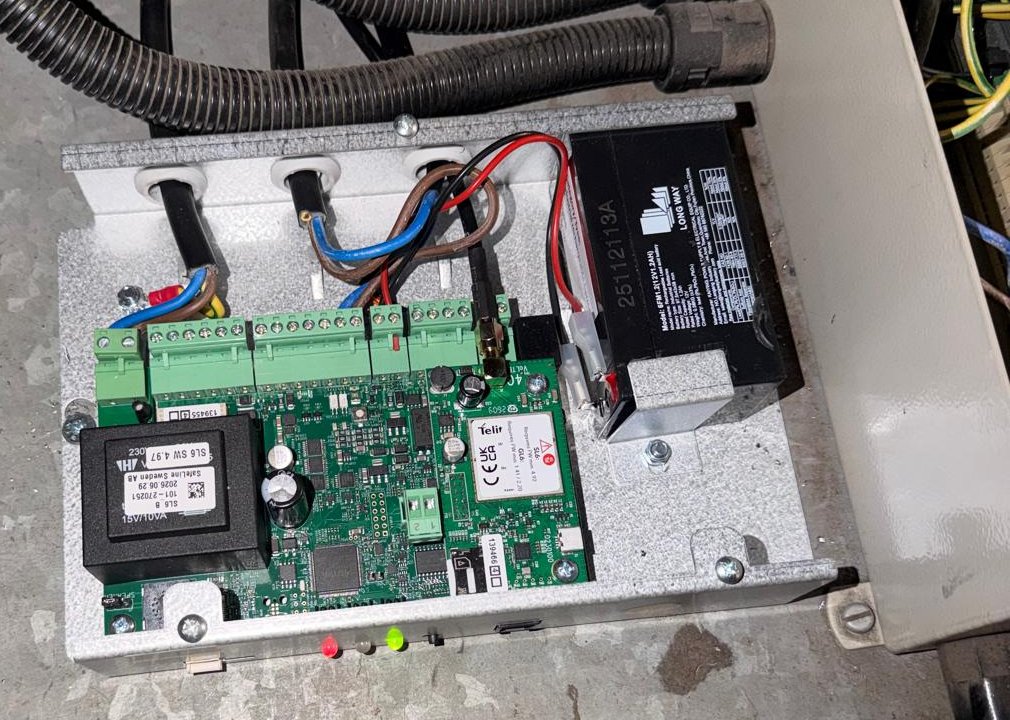
A lift alarm has to work when things go wrong, and a power cut is one of the times people are most likely to be trapped. So the alarm must still let a passenger call for help when the power fails: ask your lift company how each alarm is powered, and what happens to it during a power cut. Openreach also points out that where a digital line is used, the router needs a battery backup. If your alarm uses a GSM unit, ask how long its battery lasts and when it was last tested. Batteries wear out, and an alarm with a flat battery is no better than one with no line at all.
Don’t forget the mobile switch-off
Moving to GSM is the right fix, but check which mobile network a GSM unit uses. Ofcom reported in February 2023 that the UK’s mobile operators “do not intend to offer 2G and 3G mobile networks past 2033 at the latest”, and that they are switching 3G off first. Ofcom also noted that the switch-off “will also impact a range of other devices such as telecare alarms”.
If you already have a GSM unit in the lift, ask your lift company which network it relies on. An older unit that depends on 2G or 3G may need replacing before those networks go, so the phone line changeover is a good moment to check.
Is a lift emergency phone a legal requirement?
For lifts placed on the market under the Lifts Regulations 2016, yes. The regulations’ essential safety requirements say: “Cars must be fitted with two-way means of communication allowing permanent contact with a rescue service.” You can read them on legislation.gov.uk.
Older lifts were built to the rules of their time, but the duty to keep a lift safe for the people using it applies to every lift. A trapped passenger who can’t call for help is a serious risk. The British Standard for lift alarms, BS EN 81-28, sets out how remote alarm systems on passenger and goods passenger lifts should work. Your insurer, and the independent examiner who carries out the lift’s thorough examinations, will expect the alarm to work. We arrange LOLER thorough examinations, carried out by an independent examiner, so every examination stays impartial.
This is general information, not legal advice: if you are unsure of your duties, take advice.
Who is responsible for the lift emergency phone?
Openreach’s note sets out the usual split. Once the lift company has fitted the dialler, “the lift owner now becomes the owner of the hardware and is usually responsible for the phone line too”. It goes on: “lift alarm hardware maintenance falls to the lift company, while the router and battery backup are the responsibility of the lift owner”.
In practice, that means:
- the owner or managing agent decides on the upgrade and pays for it, and is responsible for any phone line, router and power backup;
- the lift company maintains the alarm hardware, tests it and fits the GSM unit or new dialler;
- the rescue service answers the calls and sends help.
Make sure everyone knows which part is theirs before 31 January 2027, not after.
A lift emergency phone checklist before 31 January 2027
- List every lift and who is responsible for each.
- Find out what each lift emergency phone connects through: a phone line, a GSM unit or a digital line.
- Check it works: press the alarm, and check the call reaches someone who can act.
- Check the age of each dialler and how reliable it has been.
- For GSM units, check the network it relies on.
- Decide the fix for each lift: a GSM unit or a new dialler. If you are not sure, send your lift company what you know first.
- Book the work early. With many buildings moving at once, don’t leave it until January.
- Confirm who answers the alarm calls, and that they know each lift’s address.
- Record the change in the lift’s file, with the test result afterwards.
Testing your lift emergency phone
We test the alarm and check that the call gets through on every service visit. Between visits, tell your lift company straight away if anyone reports the alarm not working, and treat it as a fault to fix, not a note for the next service.
In our experience, an alarm that isn’t working or has never been tested is one of the most common gaps we find when we take over lifts from another contractor. It is also one of the easiest to fix. A quick press of the alarm button, with someone listening at the other end, tells you more than any certificate in a drawer. If you manage several buildings, ask for the alarm test result to be included in every service report.
Lift emergency phones in blocks of flats and at work
Blocks of flats
A resident trapped in a lift late at night, perhaps with nobody else in the building, depends entirely on the lift emergency phone. In blocks where some residents can’t use the stairs, a lift that is out of action or an alarm that doesn’t connect matters even more. Our lift breakdown guide explains what happens when someone is trapped.
Offices, shops, hotels and schools
In workplaces, a lift is lifting equipment used at work, and the alarm is part of keeping it safe. Our lift maintenance page explains what a planned service covers, including the alarm test.
Questions to ask your lift company
- What does each of our lift emergency phones connect through now?
- Will it keep working after 31 January 2027?
- Do we need a GSM unit, or a new dialler?
- If it uses GSM, which mobile network does it rely on?
- Who answers our lift alarm calls, and how quickly is help sent?
- How long will the changeover take, and will the lift be out of service?
- Will we get a record of the test after the work?
If you would like us to check your lifts, use the helper and quote form above, or contact us with what you know about your lifts. Our office is open 08:00 to 17:00, Monday to Friday, on 01708 986845. Contract customers should use the number in their contract or on the lift.
Mistakes to avoid with the digital switchover
- Assuming your phone provider will sort the lift. The phone provider looks after the line, not the lift’s dialler.
- Relying on a temporary voice-only service. It may not support what a lift emergency phone needs.
- Fitting a router without battery backup. A power cut could leave the lift without a working alarm.
- Fitting GSM without checking the signal in the shaft, or the network it uses.
- Leaving it to the last month, when engineers are busiest.
Words you’ll see
- Dialler: the unit on top of the lift car that calls the rescue service when the alarm is pressed.
- GSM unit: a mobile connection for the lift alarm, with its own SIM.
- PSTN: the traditional copper phone network being switched off.
- Digital switchover: the move of every phone line to digital, ending on 31 January 2027.
- EVAc: Openreach’s temporary emergency voice-only service for lines that haven’t moved.
- Rescue service: whoever answers the lift alarm and sends help.
Questions people ask
Is a lift emergency phone a legal requirement?
Lifts placed on the market under the Lifts Regulations 2016 must have two-way communication with a rescue service, and every lift owner has a duty to keep the lift safe to use.
Will my lift alarm stop working on 31 January 2027?
If it still relies on a traditional phone line, it may. Openreach says lines that haven't switched may have limited service, so check now.
Do I need a GSM unit or a new auto dialler?
A GSM unit is usually enough for a fairly new, working auto dialler. An older or unreliable one is usually better replaced with a new auto dialler with built-in GSM. We recommend the SafeLine SL6+ 4G, an all-in-one auto dialler with built-in 4G.
How long does a lift alarm changeover take?
About half a day on site per lift is typical.
Do you test lift alarms?
Yes. We test the alarm and check the call gets through on every service visit.