Ensuring accessibility and regulatory compliance within educational buildings is a legal responsibility for every school administrator. Under the Equality Act 2010 and Building Regulations Part M, schools with multiple floors must install lifts to accommodate wheelchair users and anyone with mobility difficulties. When selecting lift installation for schools, a compliance assessment is essential, as school lift selection requires careful evaluation of legal obligations, equipment regulations, and budget constraints.
Legal Requirements and Compliance Standards for School Lifts
Educational facilities must comply with accessibility legislation to enhance accessibility and uphold legal responsibility. The Equality Act 2010 and Disability Discrimination Act specify that lifts are required in buildings with three floors or more or where physical or mental impairments limit mobility. Building Regulations Part M demand lift installations to ensure seamless integration and easy access for wheelchair users and support workers.
Non-compliance can result in legal penalties up to £5,000, inspector interventions, and forced building modifications. Facilities management, often school leadership, must budget for uninterrupted power supply, electrical emergency backup, and comprehensive equipment maintenance. Timely compliance not only meets statutory deadlines but also supports safeguarding needs and regulatory compliance across educational settings.
Building Regulations Part M Requirements
Building Regulations Part M mandate minimum accessibility standards for educational institutions. Conventional lift and platform lift specifications must include a lift shaft, with minimum internal dimensions of 1100mm x 1400mm and door widths to accommodate wheelchair users.
Step lifts are suitable for low rise buildings, but passenger lifts for larger educational buildings must offer higher load capacities (minimum 400kg), reliable intercom systems, battery backup for power cut scenarios, and emergency evacuation lift capabilities.
Approved inspectors require full documentation, including installation certificates and ongoing maintenance logs, ensuring lifts for schools remain fully operational and compliant at all times.
LOLER Inspection and Maintenance Obligations
LOLER (Lifting Operations and Lifting Equipment Regulations) require 6-monthly safety inspections for passenger lifts and annual checks for goods lifts used in school buildings. Ensuring safe operation, these inspections cover emergency procedures, uninterrupted power supply systems, and staff training for duty holders. LOLER compliance encompasses record keeping, certification updates, and immediate rectification of any faults.
Inspection fees, routine servicing, and maintenance contracts form a significant part of the lifecycle budgeting for lifts in schools. Preventative lift maintenance ensures long-term reliability and minimal disruption to daily school activities, reinforcing the importance of selecting lift experts proficient in the education sector.
Platform Lifts vs Passenger Lifts: Complete Comparison for Schools
Selecting between platform lifts and passenger lifts determines installation complexity in educational settings. Decision factors include building height, frequency of lift usage during class changeovers, space constraints, and budget allocations.
Platform lifts for schools suit low rise buildings and limited mobility requirements, whereas passenger lifts are ideal for high-traffic environments and multi-floor education sector projects. Both lift types must comply with equipment regulations, safety standards, and offer child friendly features. When comparing lift selection, consider the following:
| Feature | Platform Lifts (£7,000–£20,000) | Passenger Lifts (£16,000+) |
| Installation Time | 3 days | 2–3 weeks |
| Space Requirements | Minimal pit | Full lift shaft |
| User Capacity | 1–2 people | 3–33 people |
| Speed | 0.15m/s max | 0.15m/s+ |
Platform Lift Applications in Educational Settings
Platform lifts provide accessible vertical transport in educational facilities with low rise buildings or limited space. Their open platform design, safety edges, and emergency systems, such as intercom and battery lowering, guarantee safe operation for wheelchair users and support staff. Installation requires no machine room, enabling minimal disturbance, reduced building adaptations, and easy access for those with mobility difficulties.
Passenger Lift Systems for High-Traffic School Environments
Passenger lifts accommodate high-volume user movement needed during class transitions, equipment transport, and emergency evacuations in multi-floor school buildings. Speed efficiency (0.15m/s+), advanced features like destination control systems, and vandal-resistant designs make them ideal for larger school lift installations and educational institutions. Evacuation lift capability ensures compliance with safeguarding needs, providing reliable lift services during electrical emergency events and power cuts.
Safety Features and Vandalism Prevention in School Lifts
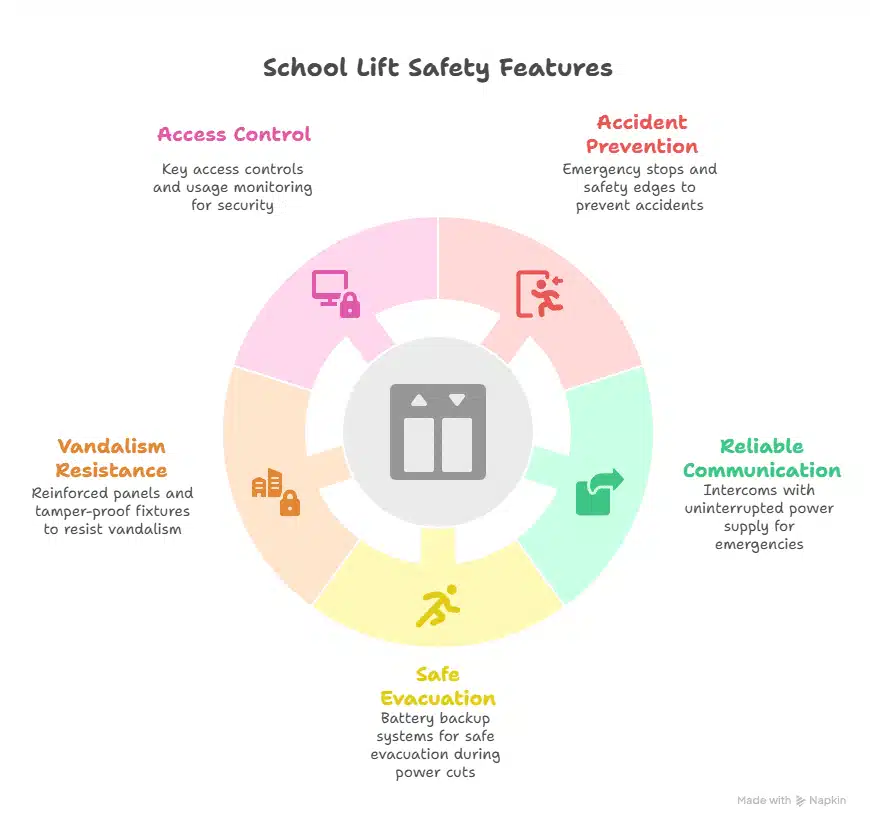
School lift safety features are designed to prevent accidents, support uninterrupted operation, and protect equipment from vandalism in educational settings. Essential specialist protections include:
- Emergency stops and safety edges for accident prevention
- Intercoms with uninterrupted power supply for reliable communication during electrical emergencies
- Battery backup systems allowing safe lift evacuation during a power cut
- Reinforced panels and tamper-proof fixtures to resist vandalism and extend operational lifespan
- Key access controls and usage monitoring for safeguarding younger children and limiting unauthorised use
Installation Considerations and Space Requirements
Lift installation procedures and planning affects project timeline and costs, requiring expert space analysis (shaft, pit depth, headroom, access routes) and site assessments. Building adaptations need load-bearing evaluations, foundation works, and lift shaft construction.
Heritage considerations for listed buildings may mandate conservation approvals and phased installation processes to minimise operational disruption. For new construction, close collaboration with architects allows for optimal lift placement, futureproofing, and seamless integration into the educational facility’s architecture and utility plan.
Selecting the Right Lift Service Provider and Installation Team
Service provider selection determines installation success and long-term reliability. Prioritise companies with industry certifications, education sector experience, and strong lifting operations safety records. Lift experts should offer comprehensive lift installations, robust maintenance programmes, and 24/7 emergency support.
Contract terms must address warranty coverage, rapid response times, parts availability, and cost transparency. Choosing fully DBS-checked engineers for school lift services ensures safeguarding, legal compliance, and smooth project fulfilment with minimal disruption to teaching and learning environments.
Closing Thoughts
Choosing and installing lifts for schools is a complex decision involving legal requirements, technical standards, and comprehensive maintenance obligations. By understanding building regulations, comparing platform and passenger lift solutions, integrating vital safety features, and selecting knowledgeable lift experts, educational institutions can enhance accessibility and ensure safe, fully operational equipment for decades to come.
At Future Lift Services, we provide brand new, professional and modern lift installations.
We can also provide quotations to modernise existing systems that are inefficient or out of date, as well as competitive quotes for a brand new installation as part of a new development. With years of experience, we can create the perfect system for your building. Why wait?
To find out more about our professional lift installation services, or to request a quote, contact us today.
FAQs
What is the importance of an intercom with uninterrupted power supply in school lifts?
An intercom uninterrupted power supply is vital for lift safety in educational buildings, especially during a power cut or electrical emergency. This system ensures that staff and students can always communicate with support workers or emergency responders if they become stuck in a lift, regardless of the building’s power status, guaranteeing safe operation and enhanced safeguarding protocols.
Are wheelchair lifts suitable for all school buildings with accessibility needs?
Wheelchair lifts offer an excellent solution for schools aiming to enhance accessibility for wheelchair users and those with limited mobility, particularly in low rise buildings or spaces with restricted room for a conventional lift shaft. They are designed for easy access, safe operation, and minimal disturbance during installation, making them ideal for educational settings seeking regulatory compliance and fully operational equipment.
How does lift modernisation compare to installing new lifts in schools?
Lift modernisation allows educational institutions to upgrade outdated equipment, improve safety standards, and integrate new features such as advanced intercoms or battery backup systems without the expense of installing entirely new lifts. This process often involves updating controls, safety barriers, and accessibility adaptations, ensuring lifts remain compliant with current regulations and continue to serve the vital role they play in school.