

Elevators are significant intermittent consumers of electricity — the instantaneous power demand during a trip can be a thousand times greater than standby consumption. Yet most building managers have no clear picture of what their lift actually costs to run each year. This guide gives you the real numbers, explains how lift type and usage pattern affect consumption, and tells you what a genuine energy retrofit looks like in practice.
According to data from Kone, a typical hydraulic elevator in a three-storey office building requires 3,800 kWh of energy annually — equating to roughly 10.4 kWh per day. But that figure masks huge variation depending on lift type, traffic, speed, and whether any energy-saving controls are fitted.
A Quick Guide to Lift Power Consumption
Lift power consumption refers to the amount of electrical energy a lift uses to operate. This includes the energy required to overcome gravity, carry heavy loads, and perform movements such as ascending, descending, and stopping. Whether the lift is idle or in motion, its power consumption can significantly impact energy costs, particularly in high-use buildings like offices and residential complexes.
Lifts with high energy consumption often result from inefficiencies in their design or operation. Factors such as load weight, energy rating, and lift type (hydraulic vs traction) play crucial roles. Understanding lift power consumption helps building managers make informed decisions about installing or upgrading lifts.
What Affects How Much Electricity a Lift Uses?
The key variables are: number of people using the lift regularly; hydraulic vs traction drive system; geared vs gearless; braking technology (regenerative or dissipative); acceleration profile; and whether the control system can plot the most energy-efficient route. Recent research has identified lift velocity and acceleration as the leading factors influencing energy performance.
Types of Energy-Efficient Lifts and Their Energy Consumption
Hydraulic Lifts
A typical hydraulic elevator in a three-storey office building requires 3,800 kWh of energy annually, equating to 10.4 kWh per day. These systems are most common in buildings with seven storeys or fewer. The energy efficiency is largely determined by travel distance — friction from oil flowing through hydraulic valves generates heat that must be removed by the building’s cooling system on the descent.
Geared Traction Lifts
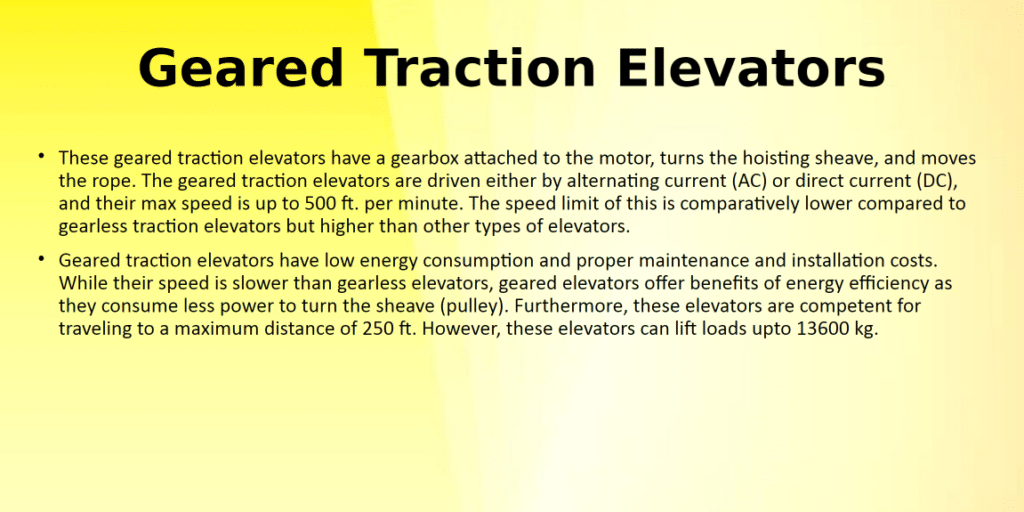
Traction elevators use counterweighted pulleys to raise and lower the car, which reduces energy compared to hydraulics. One study shows traction elevators use 14–270 kJ for a four-floor ride, while hydraulic elevators use over 400 kJ. The direction of travel matters significantly: a fully loaded car going up consumes more energy than a fully loaded car going down, because the counterweight compensates on descent.
Gearless Elevators
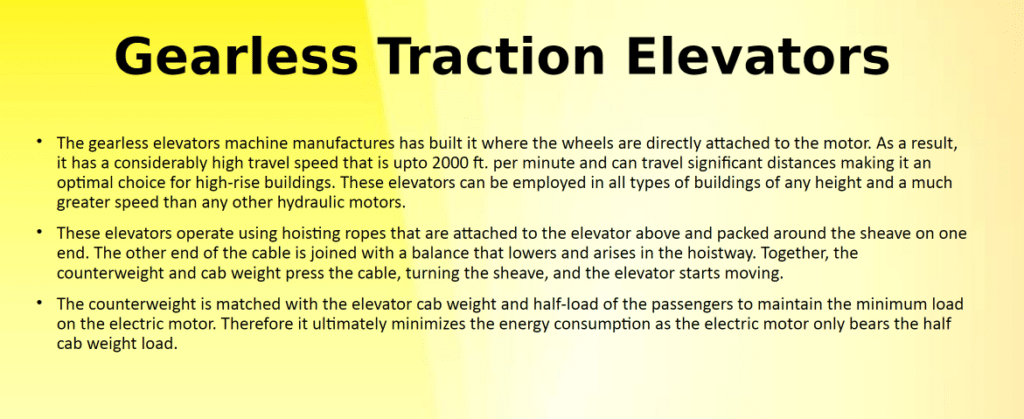
Gearless lifts are a subtype of traction lift that eliminate the gearbox entirely. They operate at higher speeds with less friction, making them exceptionally quiet and smooth. However, they are not always more efficient than geared traction lifts — the efficiency advantage depends heavily on the building’s traffic pattern.
How Much Energy Does a Lift Use?
A conventional passenger lift requires approximately 3,750 watts of power in standby mode and up to 15,000 watts when carrying a full load of 4–6 people. That translates to approximately 0.21 kWh per hour at standby and 0.83 kWh per hour at full load. High-speed lifts use roughly 50% more energy than low-speed equivalents. A larger lift requires proportionally more energy because of the additional weight it must move.
Looking for Energy-Efficient Options for Your Lift?
Future Lift Services are specialists in lift installation, maintenance, and modernisation for commercial and residential buildings across Essex and London. We are CHAS Accredited and SafeContractor Approved, and our engineers can advise on the most energy-efficient specification for your building.