Last updated:
Whether you manage offices, shopping centres, or public buildings, choosing to install lifts isn’t just about meeting regulations, it’s about providing access solutions that serve everyone, including wheelchair users and people with limited mobility. Commercial lift installation offers the latest technology to improve accessibility across the UK, supporting tenants, staff, and customers.
If you’re considering new lift installation, this guide will break down each project phase, highlight key safety regulations, and show you how partnering with the right lift company delivers competitive pricing, bespoke lifts, and ongoing support that keeps your investment running smoothly.
Why Commercial Lift Installation Matters
The Compliance Imperative: Meeting the Equality Act
Installing commercial lifts in your property isn’t just good practice, it’s a legal must for most commercial buildings across the UK. The Equality Act 2010 requires business owners to make “reasonable adjustments” so everyone, including wheelchair users and those with limited mobility has equal access throughout the site. This means:
- A passenger lift or platform lift is usually required for multi-level offices or public buildings.
- Glass lifts and bespoke lift solutions not only meet access needs but also align with stylish design goals.
- Failure to install lifts can leave your business open to complaints or even legal action for non-compliance, as regulations demand accessibility for staff, visitors, and customers alike.
Inclusive Access: Serving All Building Users
Modern lift solutions play a major role in creating commercial spaces that are truly open to everyone:
- For wheelchair users and those with limited mobility: Instantly removes barriers, letting everyone reach all areas safely and independently.
- For staff and customers handling heavy or bulky goods: Service lifts and goods lifts streamline movement, reducing injury risks and improving operational efficiency.
- For busy environments like shopping centres or offices: More efficient people flow, less congestion, and happier customers.
Future-Proofing and Competitive Advantage
- Accessibility regulations are only getting stricter so investing in the latest technology protects your site from future compliance headaches.
- Businesses that offer maintenance packages and ongoing lift maintenance enjoy fewer repairs, minimised downtime, and long-term support for their customers and teams.
- For tenants, knowing a site is serviced by a reputable lift company signals reliability and a commitment to safety. In offices and public buildings, this boost in confidence supports stronger, longer leases.
Each of these points underlines why a “wait and see” approach is riskier than investing now in modern commercial lift solutions. Not only will you improve accessibility and user experiences, you’ll also build value into your commercial building project, meeting the highest safety regulations and preparing for the needs of every user, today and tomorrow.
Key points:
- More than 14 million people in the UK live with a disability; access solutions are no longer optional.
- Meeting and exceeding safety regulations protects everyone and minimises repairs down the line.
Pre-Installation Stage – Planning, Surveying, and Regulations
Detailed planning lays the foundation for a safe, compliant lift installation:
- Site surveys are performed to ensure the structure can support new equipment.
- Contractors review UK building codes, the Health & Safety at Work Act 1974, and local permit requirements.
- In most projects:
- Approvals must be secured from local authorities.
- The lift company will handle compliance including planning consents and fire safety clearance so you don’t have to chase paperwork.
Checklist:
- Inspect building for suitability.
- Consult existing safety standards and regulations.
- Secure all permits before ordering equipment.
- Check lift pit depth requirements
Tailored, fully compliant lift solutions always start with careful project management and collaboration across your team.
Contact us for commercial lift installation advice.
Design & Customisation – Meeting Building and User Needs
Every site and use case calls for a different approach. Your team will work with architects and the lift company to design bespoke lifts that match your needs, space, and budget.
Key choices include:
- Passenger lifts for regular foot traffic in offices.
- Platform lifts providing wheelchair access in public buildings.
- Glass lifts that showcase modern lift design ideas in high-traffic environments.
- Service lifts engineered for bulky or heavy goods in shopping centres or warehouses.
| Feature | MRL Lifts | Passenger Lifts | Platform Lifts |
| Space Required | Low | Medium | Varies |
| Suitable For | Offices, retail | Hotels, offices | Disabled access, public use |
| Price Range | ££ | £££ | £/££ |
Process highlights:
- Choose finishes, controls, capacity, and install location.
- Design with site needs, frequency of use, and maintenance in mind.
- Review maintenance packages for lasting performance and compliance.
Site Preparation – Setting Up for Safe Installation
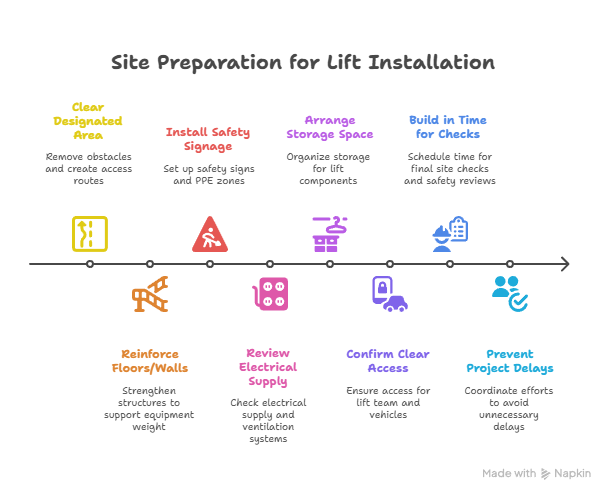
Proper site preparation ensures smooth delivery and safe, efficient installation:
- Tasks before delivery:
- Clear the designated area and create access routes.
- Reinforce floors/walls for the equipment’s weight.
- Install safety signage and establish PPE zones.
- Review electrical supply and ventilation for both the shaft and equipment room.
Bullet list:
- Arrange storage space for lift components.
- Confirm clear access for the lift team and supply vehicles.
- Build in time for final site checks and safety reviews before starting work.
Your facilities team and contractor work together to prevent unnecessary project delays.
The Installation Process – Mechanical and Electrical Work
Physical lift installation consists of multiple, tightly coordinated phases. A skilled installation team, including mechanical engineers and electricians, ensures everything is fitted safely and on schedule.
- Phases:
- Deliver and position base, shaft, and major machinery.
- Assemble cab, counterweights, doors, and safety features.
- Complete wiring, configure control panels, and integrate the latest technology.
| Stage | Typical Time (Days) | Key Tasks |
| Site Prep | 1–3 | Clearing, reinforcement |
| Shaft/Base | 2–5 | Build, alignment |
| Assembly | 3–7 | Cab, machinery, wiring |
| Testing | 1–2 | Functional, safety |
Key points:
- Service lifts and platform lifts are often installed faster than large passenger lifts.
- All work is performed to strict safety regulations; compliance is reviewed at every step.
See Also: Complete Guide to Lift Shaft Design in Commercial Buildings
Quality Assurance & Testing – Ensuring Safety and Compliance
- The lift undergoes rigorous testing to meet standards like BS EN 81 and LOLER 1998.
- Tests include:
- Load/weight verification
- Electrical and emergency device checks
- Functional inspections
When a new lift installation passes all tests, an official certificate is issued confirming safe operation and full compliance.
Bullet list:
- Independent inspectors review every system.
- Documentation is provided for ongoing lift maintenance and regulatory purposes.
- No lift is placed in service without a final sign-off.
This process guarantees that tenants, staff, and customers move safely. No compromises.
Handover, Staff Training & Ongoing Maintenance
A trustworthy lift company supports you beyond handover:
- Comprehensive staff training covers safe operation and troubleshooting of passenger lifts, service lifts, and platform lifts.
- Maintenance packages are tailored to your equipment and usage helping avoid costly repairs and downtime.
- Documentation includes user manuals, service logs, and details about recommended repairs and replacements.
Checklist:
- Schedule regular servicing to maintain equipment and comply with safety regulations.
- Set up staff training for new starters.
- Establish direct contact with your local support team for rapid response.
The right service keeps your lift investment running safely for years.
Timeline & Budget Considerations for a Lift Project
Managing a new lift installation demands sound scheduling and budget control:
Key factors that can affect your project:
- Poor site conditions requiring extra preparation
- Commercial lift installation cost
- Complex, bespoke lifts needing longer design or supply times
- Regulatory reviews or permit delays anywhere across the UK
- Discovery of structural issues only visible during works
Bullet list:
- Build flexibility into your timeline for unexpected issues.
- Work closely with your lift company’s project manager to monitor progress.
- Choose competitive pricing and clearly defined maintenance packages from the outset.
Transparent project management reduces headaches, ensuring efficient delivery and lasting results.
Closing Thoughts
By investing in commercial lifts, you’re unlocking your building for every user, now and far into the future. The success of any new lift installation, whether it’s a glass lift, platform lift, or passenger lift, comes down to proper planning, expert delivery, and ongoing lift maintenance from a dedicated team. If you want tailored solutions, competitive pricing, and true peace of mind, reach out to a specialist lift company for end-to-end project management, support, and repairs.
Contact us today for a free consultation on your lift project.
FAQs
What permits are needed for a commercial lift?
Building regulations approval, fire safety clearance, and planning consent if the lift is visible externally.
How long does lift installation take?
Most standard installs are completed in 6–12 weeks, with some bespoke lifts requiring more time for design and delivery.
What maintenance is required for new lifts?
Scheduled lift maintenance, emergency repairs, and regular safety inspections at least twice a year, with extra attention for lifts in busy public buildings or those moving heavy goods.