Ensuring accessibility in public and commercial buildings across the UK is both a legal obligation and a strong contributor to social inclusion. The installation and maintenance of lifts for public buildings directly affect how easily all individuals, including disabled persons and wheelchair users, can access different floors of public space and commercial facilities.
Whether evaluating installation cost, design vision, or ongoing service, understanding current legislation and building requirements is essential for building managers, property owners, and anyone responsible for vertical access.
This blog offers expert advice and clear, actionable guidance to future proof every project, making sure lifts are installed, maintained, and fully compliant with statutory regulations.
Core Legal Framework and Statutory Requirements
The Equality Act 2010: Foundation for Accessible Design
The Equality Act 2010 places a primary obligation on building owners to make reasonable adjustments, ensuring that disabled persons can access goods lift, commercial lifts, and all public spaces without substantial disadvantage. This statutory requirement applies to workplaces, educational facilities, offices, shops, hotels, and any UK building where public or commercial activities occur.
Failure to accommodate disabled access lift requirements exposes owners to discrimination claims and enforcement action, making compliance essential for all vertical lifts and platform lifts installed in public and commercial spaces.
Building Regulations Part M: Accessibility Requirements
Building Regulations Part M divides requirements for lifts into Volume 1 for domestic buildings and Volume 2 for non-domestic premises. Both enforce reasonable provision for disabled access to every facility on different floors, including open platform lifts and step lifts where a passenger lift is not feasible. Compliance is overseen by Local Authority Building Control and Approved Inspectors, safeguarding accessibility and verifying every installation against current standards.
Integration with Fire Safety Regulations
All vertical platform lifts and residential lifts must integrate with fire safety standards. Approved Document B, alongside BS 9991:2024, covers requirements for both firefighting lifts and evacuation lifts, particularly in high-rise or multi-storey buildings. The best types of lifts for commercial use must be future proofed with fire-resistant enclosures and emergency power to ensure the safety of limited mobility users in every public and commercial building.
Mandatory Lift Provision Requirements
When Lifts Are Required
Hydraulic passenger lifts are strongly recommended for all buildings with two storeys or more, especially where the public, wheelchair users, or employees need access to several levels. In commercial spaces such as offices, hotels, restaurants, and shopping centres, disabled access lifts are essential to meet legal requirements and to ensure building work enhances vertical access for all users.
Preferred Solutions Hierarchy
The preferred solution is always a full passenger lift meeting Part M specifications. Where this is not feasible, platform lifts or open platform lifts offer suitable alternatives, with wheelchair platform stairlifts considered only in existing buildings with physical constraints. In all cases, an access statement is required to justify the choice of lift and confirm that accessibility and equality act standards are being met.
New Build vs Existing Building Requirements
For new buildings, installation of passenger lifts is presumed in planning. Any material alterations to existing buildings, especially those handling design in historic or listed structures, must improve disabled access while respecting the building’s heritage and style. Site-specific lift design and installation must balance safety, accessibility, and aesthetic appeal as outlined in client data sheets.
Physical Design and Dimensional Requirements
Minimum Lift Car Specifications
UK legislation mandates minimum internal dimensions for lift cabins to accommodate passengers and wheelchair users:
- Standard lift: 1100mm wide × 1400mm deep
- Enhanced lift: 1200mm wide × 2300mm deep (17-person lift)
- Mixed use (standing plus wheelchair): 2000mm wide × 1400mm deep
- Minimum load capacity: 400kg, ensuring reliable performance for accessible mobility.
Door and Landing Specifications
To optimise accessibility for lifts in public buildings:
- Lift doors must provide 800mm minimum clear width (900mm recommended for new construction)
- Landing space needs 1500mm × 1500mm clear for wheelchair manoeuvring
- Visual contrast between doors and lobby walls is required
- Level access between car and landing, with a gap no greater than 25mm.
Control and Interface Requirements
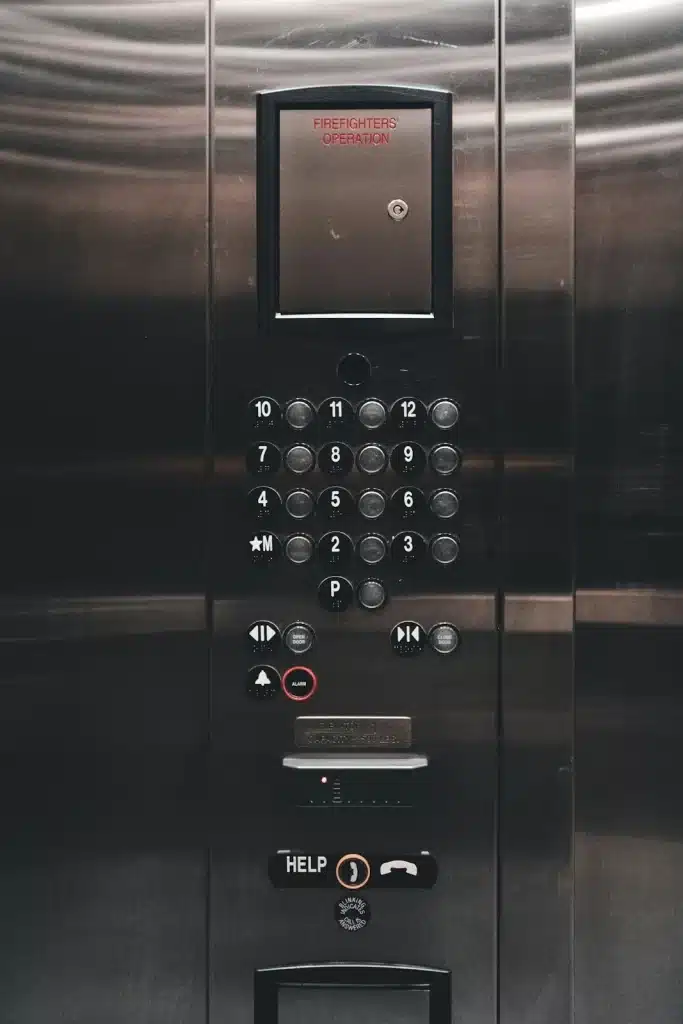
Controls should suit both standing persons and wheelchair users, positioned at an accessible height. Tactile and visual indicators improve usability, while emergency call buttons must be placed for easy access by those with limited mobility, ensuring every public building and commercial elevator offers reliable emergency support.
Safety Systems and Emergency Communications
Mandatory Emergency Communication Systems
All lifts installed since 1998 must be equipped with two-way communication systems, meeting BS EN 81-28 standards. These systems must connect to a staffed centre for 24/7 monitoring and allow emergency contact from the lift car, machine room, car top, and lift pit areas, supporting passengers at all times.
Communication System Technical Requirements
To meet legal and performance standards, lift emergency systems require:
- Minimum 8-hour emergency battery backup
- Automatic alert location and identification for responders
- PSTN phone lines are being replaced by digital/IP connectivity (due in 2027)
- Solutions may include analogue, GSM, VoIP, or cellular options.
Emergency Communication Standards
BS EN 81-1, 81-2, and 81-80 set out comprehensive safety improvement rules for both new and existing lifts, ensuring that alarm devices and safety systems are installed, maintained, and properly tested according to the latest industry standards.
Maintenance and Inspection Obligations
LOLER (Lifting Operations and Lifting Equipment Regulations) 1998
To ensure reliability and safety, passenger lifts in public and commercial spaces must be thoroughly examined, according to LOLER requirements, at least every 6 months, with inspections performed by an impartial and technically competent person. All records, including examination certificates and pre-use reports, must be kept up to date.
PUWER (Provision and Use of Work Equipment Regulations) 1998
Ongoing maintenance, regular servicing, and clear marking of safe working loads are required for all lifts, with operation restricted to trained staff. Strict compliance safeguards liability insurance, protects building occupants, and ensures service continuity.
Compliance Documentation and Record Keeping
Full maintenance logs and defect reports must be maintained, with immediate action for any safety fault. Valid inspection certificates are required for all installed platform lifts and commercial elevators, directly affecting insurance and liability.
Special Requirements and Evacuation Provisions
Evacuation Lift Requirements
BS 9991:2024 introduces new evacuation lift standards for high-rise residential buildings, mandating lifts in fire-resistant shafts and specifying minimum heights for both evacuation and firefighting provision. Buildings over 50m must include evacuation lift capability, while those above 18m are subject to firefighting lift requirements.
Firefighting Lift Specifications
Firefighting lifts must be equipped with secondary emergency power and tested regularly, serving dual purposes in residential settings. Their protected installation ensures safety for both fire service access and evacuation, with ongoing testing required for recall systems and backup power.
Future Standards Development
BS EN 81-76 is due to set enhanced standards for European evacuation lifts in 2025, with stricter requirements for structural integrity and fire protection, and mandatory integration with building fire safety systems.
Compliance Planning and Implementation
Access Statements and Justification
When full passenger lifts are not provided, an access statement must detail why alternatives were chosen (e.g. step lifts or platform lifts), address equality considerations, and specify the measures taken to ensure accessibility for all, especially wheelchair users and those with limited mobility.
Design Team Responsibilities
Architects, building control professionals, and lift specialists each have a role in ensuring designs meet Part M and all current legislation. Every access lift and commercial elevator must be designed through collaborative planning, with technical validation for lift design, aesthetic appeal, and ongoing service requirements.
Cost-Benefit Considerations
Providing reliable lifts and improving accessibility enhances building efficiency and asset value. The ‘Purple Pound’, the combined annual income of disabled people in the UK, valued at £274 billion, illustrates the substantial economic incentive for compliance and accessible design. Legal risk from non-compliance includes costly discrimination claims and retrofit expenditure.
Closing Thoughts
Meeting the UK’s legal requirements for lifts in public and commercial buildings isn’t simply about ticking compliance boxes, it’s about making every public space welcoming, accessible, and safe for everyone. Whether installing vertical platform lifts, maintaining goods lifts, or updating residential lifts to the latest standards, each decision influences mobility, equality, and the value of every building.
We offer first-rate installation and maintenance services for lifts in workspaces, public buildings, and other commercial structures.
Book your free, no-obligation quote today!
FAQs
How many floors can commercial lifts serve in a typical UK public building?
Commercial lifts in the UK are designed to accommodate a wide range of floor levels, from two-storey public buildings to high-rise offices and other public space developments. The exact number of floors a lift can serve depends on several factors including the building’s height, usage, and layout, as well as the type of lift selected.
What’s the right lift for a building with specific needs or mixed floor levels?
Choosing the right lift for commercial or public spaces with unique requirements involves assessing accessibility, capacity, and site constraints. For example, platform lifts may suit lower-rise buildings or sites with limited space, while passenger lifts are ideal for serving several floor levels efficiently. Consulting a lift specialist to offer advice ensures solutions are tailored to the building’s specific needs and compliance requirements.
What are the key factors to consider when installing lifts in offices or other public space projects?
Selecting and installing commercial lifts should account for floor levels, volume and type of users, heritage considerations, and legal compliance. Several factors such as installation cost, building use, travel speed, and design vision also play a role. Working with experienced providers helps offer advice on the best solution for ensuring accessibility, efficiency, and the long-term value of the installation.