
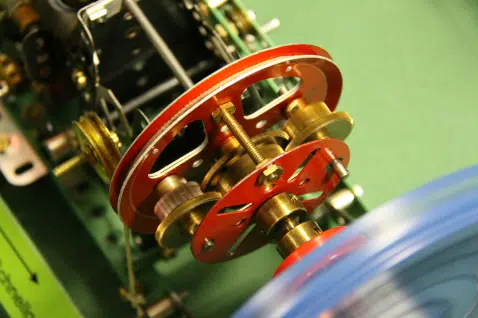
When one of our engineers visits a commercial building for a routine maintenance check, the sheave and pulley system is one of the first things they inspect — and one of the most revealing. Worn rope grooves, flattened cable contact surfaces, or uneven bearing wear are early indicators of a system heading toward an unscheduled breakdown. Most passengers never think about the mechanics above them. Building managers often don’t either, until the lift stops between floors at 5pm on a Friday.
Elevators, those ingenious inventions that effortlessly transport us between floors in buildings, rely on a fascinating array of mechanisms to function smoothly. Among these, pulleys play a crucial role. Maintaining a lift’s pulley system is essential for its longevity and safety.
Over 7 billion elevator journeys are made every day, but it’s rare that a passenger will ever stop and think about the mechanics behind their upward journey! By understanding how pulleys are used in elevators, we gain a deeper appreciation for the engineering marvels that shape our modern world.
In this article, we’ll delve into the intricate workings of elevator pulley systems, exploring how they utilise simple machines to lift heavy loads with ease and efficiency.
Understanding Pulleys
Pulleys are one of the six classical simple machines, alongside the likes of levers, inclined planes, and screws. They work on the principle of redirecting force, making it easier to lift or move heavy objects. The fundamental design of a pulley consists of a grooved wheel and a rope or belt that runs along its groove. When force is applied to one end of the rope, the pulley rotates, exerting force in a different direction.
Pulleys are ancient devices, dating back thousands of years. They were utilised by civilizations such as the Egyptians and Greeks for various tasks, from lifting heavy stones during construction to drawing water from wells. Over time, pulley designs have evolved, becoming more sophisticated and efficient.
One of the key advantages of pulleys is their ability to provide mechanical advantage. This means that they can multiply the force applied to them, allowing users to lift or move heavier loads than would be possible with direct force alone. By distributing the load across multiple pulleys or changing the direction of the force, pulley systems can achieve significant mechanical advantage.
In the context of elevators, pulleys serve as integral components of the lifting mechanism. By incorporating pulleys into the system, elevators can overcome the force of gravity and transport passengers and goods between different floors of a building with relative ease. The use of pulleys in lift installation highlights the ingenuity of leveraging simple machines to accomplish complex tasks efficiently.

Types of Pulley Systems in Elevators
Elevators make ingenious use of this simple machine, including pulleys, to operate smoothly and efficiently. One of the fundamental principles leveraged by elevators is the inclined plane. By employing inclined planes within the elevator shaft, the system can reduce the amount of force required to lift the elevator car.
Traction Pulley Systems
Traction pulley systems are the cornerstone of modern lift technology. These systems utilise traction between the pulley and the elevator car to move vertically within the shaft. The traction pulleys are directly driven by an electric motor, which imparts rotational motion to the pulleys, subsequently moving the elevator car up or down.
In traction pulley systems, the elevator car is typically suspended by steel cables or belts that wrap around the traction pulleys. As the motor turns the pulleys, friction between the pulley surface and the cables/belts generates the necessary force to lift or lower the elevator car. This design allows for precise control over the speed and direction of the elevator’s movement.
One of the key advantages of traction pulley systems is their efficiency. By leveraging electric motors, these systems can achieve smooth and consistent vertical transportation with minimal energy consumption. Additionally, traction pulleys offer greater flexibility in terms of speed regulation and can accommodate varying loads with ease.
What FLS engineers look for when inspecting a traction sheave system: rope groove wear is the critical measure. The standard check is to hold a straight-edge across the sheave face — if the top of a rope groove is worn level with the land between grooves, the sheave needs machining or replacement.
We also check for differential groove depths (which indicates uneven load distribution across the ropes), bearing noise under rotation, and any signs of rope imprinting on the sheave face. A sheave in poor condition doesn’t just affect efficiency — it accelerates rope wear, which is a safety-critical item under LOLER.
Fixed Pulley Systems
Fixed pulley systems, although less common in modern elevator designs, play a crucial role in providing stability and support within the elevator shaft. Unlike traction pulleys, which actively drive the movement of the elevator car, fixed pulleys remain stationary and serve to redirect the force exerted on the elevator system.
In fixed pulley systems, the elevator car is typically suspended by cables or ropes that pass over fixed pulleys positioned at strategic locations within the shaft. These fixed pulleys help distribute the load evenly across the system, preventing excessive strain on individual components and ensuring smooth operation.
While fixed pulley systems do not directly contribute to the vertical movement of the elevator car, they are essential for maintaining balance and alignment throughout the elevator’s travel. By evenly distributing the load, fixed pulleys help prevent issues such as uneven wear on cables, which can compromise safety and reliability.
Moveable Pulley Systems
Moveable pulley systems are another variation commonly used in elevator design, particularly in applications where mechanical advantage and load distribution are critical. In a movable pulley system, one end of the rope or cable is fixed, while the pulley itself is free to move along the length of the rope.
The moveable pulley is attached to the elevator car, allowing it to move vertically within the shaft. As the elevator car ascends or descends, the moveable pulley adjusts its position accordingly, redistributing the load and providing mechanical advantage to the system.
Moveable pulley systems offer several advantages, including increased efficiency and reduced friction. By allowing the weight of the elevator car to be distributed more evenly, moveable pulleys help minimise wear and tear on the system components, resulting in smoother operation and extended service life.
Multiple Pulleys
In some elevator designs, multiple pulleys are employed to further enhance efficiency and distribute the load evenly. By incorporating multiple pulleys into the system, elevator engineers can achieve greater mechanical advantage, making it easier to lift heavy objects with minimal effort.
Safety Systems in Elevator Pulley Systems
Safety is paramount in elevator design, and pulley systems are no exception. Various safety mechanisms are integrated into elevator systems to prevent accidents and ensure passenger well-being. These may include emergency brakes, overload sensors, and redundant systems to mitigate the risk of failure.

What a Pulley and Sheave System Inspection Covers
During a planned preventive maintenance visit, an FLS engineer carries out a structured check of the rope and sheave system that goes beyond visual inspection. The core checks cover: sheave groove wear and profile, rope condition across all suspension ropes (measuring diameter, checking for broken wires and kinks), diverter pulley condition and alignment, counterweight sheave wear, and rope attachment anchorage points. Any defect at safety-critical components (ropes, sheave, safety gear) is escalated as a LOLER reportable item, and the lift is taken out of service until rectified.
Looking for Expert Lift Modernisation and Maintenance
Pulleys play a vital role in the functioning of elevator systems, facilitating the smooth and efficient movement of elevator cars within buildings. Whether through traction pulleys driven by electric motors or fixed pulleys distributing the load, these simple machines contribute to the seamless vertical transportation we often take for granted.
Future Lift Services are experts in lift installation, maintenance, and modernisation for all types of commercial and residential facilities. If your lift is showing signs of rough travel, unusual noise, or increased vibration, these are often the first indicators of sheave or rope wear that should be assessed before they become more serious faults.
Contact us today to arrange a maintenance visit or technical inspection.
Future Lift Services are experts in lift installation, maintenance, and modernisation for all types of commercial and residential facilities.